
Why do most people over 40 require glasses for near vision?

Roshna Bhuju
17 February, 2026 | 4 min readWhy many Doctors Fail NMCLE — How You Can Pass on Your First Attempt?

Dr. Shubham Shrestha
17 February, 2026 | 8 min read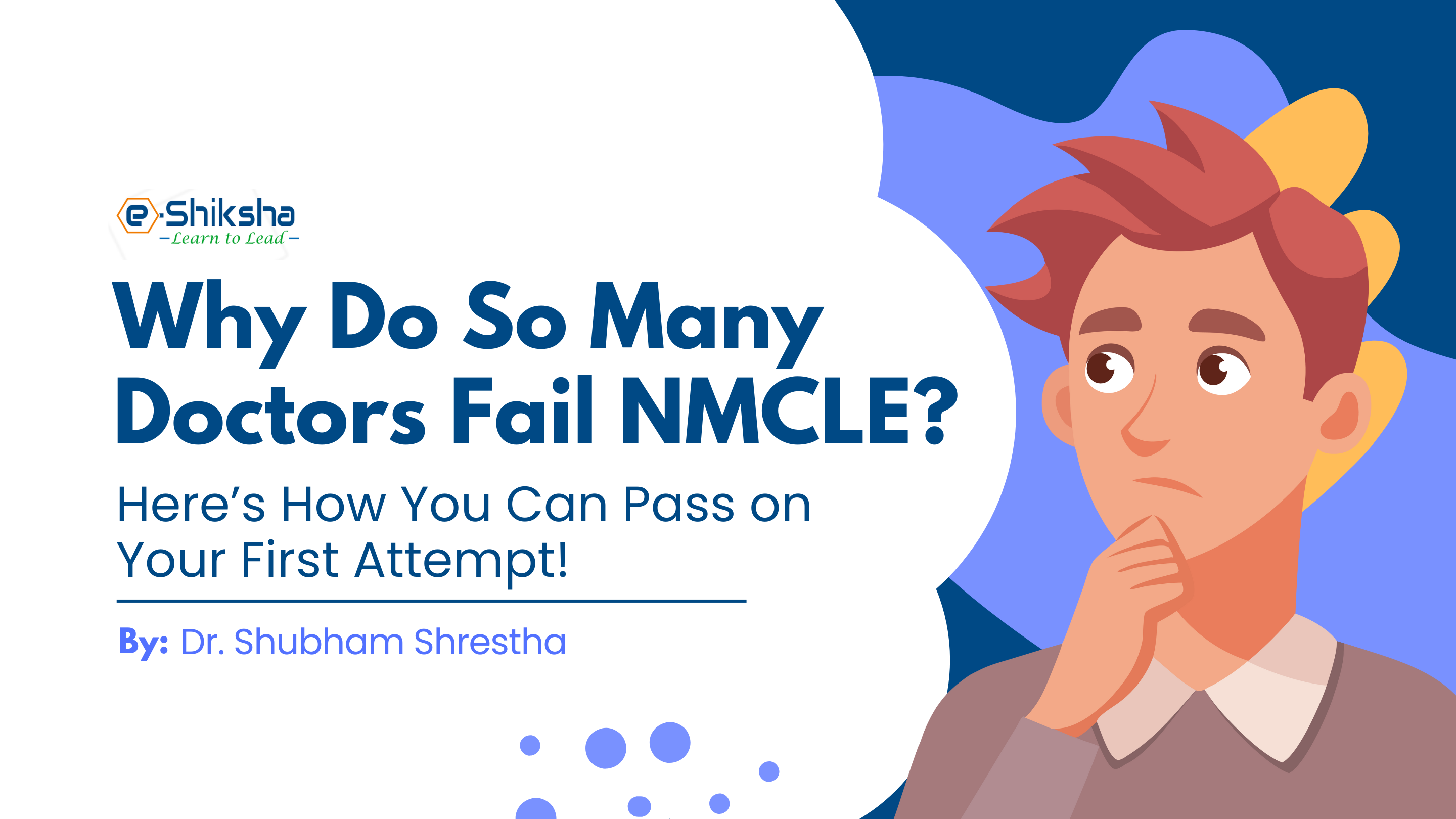
2 Likes
83 views
“I Studied Everything… Still Failed NMCLE.”
That single sentence has broken more confidence than any difficult MCQ ever could.
Every year, after months of preparation, countless medical graduates walk out of the NMCLE exam hall with the same heavy thought: “I knew this… but not like this.” They replay questions in their heads, remember reading the topic somewhere, and yet feel betrayed by their own preparation. If this thought scares you, that’s good — it means you’re honest. And honesty is the first step to passing NMCLE.
Let me tell you a story you’ll recognize immediately.
A Story Every Intern Knows (But No One Talks About)
Dr. ABC (name changed, pain real) was one of the average students in his batch. Regular in duties, steady in academics; he had never failed a medical college examination and often scored well. During internship, consultants and seniors consistently praised his hard work. By conventional standards, he was prepared, sincere and far from careless.
NMCLE का लागि Dr. ABC ठीक त्यही गरे जुन धेरै सीनियरहरुले सल्लाह दिएका थिए: उनले standard textbooks पढे, notes बारम्बार revise गरे, र अलिकति MCQs solve गरे। सीनियरहरुको कुरा सुनेर खुशी पनि थियो:
“Ward मा काम गर्ने, duty गर्ने मान्छे NMCLE पास भैहाल्छ। यही कुरा त सोध्ने हो।”
Going into the exam, he felt ready.
Then the paper began.
The first question asked for the most appropriate next step. The second wanted the best initial investigation. By the third question, two options looked equally correct and Dr. ABC found himself arguing internally with the examiner. By question fifty, he wasn’t recalling medicine anymore — he was trying to guess what the examiner was thinking.
When the results came out, Dr. ABC had failed.
Here is the uncomfortable truth: Dr. ABC didn’t fail because he didn’t study enough. He failed because he studied in a way that NMCLE does not reward.
The Biggest Lie About NMCLE
One of the most harmful pieces of advice in medical colleges is also the most common: “Just read well and you’ll pass.” This may work for university exams, but NMCLE plays by a different rulebook.
You do not read your way through NMCLE. You think your way through it.
NMCLE rarely asks you to define a disease or list diagnostic criteria. Instead, it presents you with a clinical scenario/one-line clinical concept and asks what you will do first, next, or best. The focus is not on what you know in isolation, but on how you prioritize, how you eliminate options and how you make decisions when multiple answers seem plausible.
This exam does not reward memory alone. It rewards clinical reasoning under uncertainty.
NMCLE Is Not an Exam. It’s a Filter
At its core, NMCLE is designed to answer one question: Can you function as a safe doctor on Day One?
That is why the options often feel unfair. Four answers may all be factually correct, but only one is safest, most appropriate, or most logical in that specific context. Your favorite textbook line may appear in one option, yet another option quietly outperforms it because it aligns better with real world decision making.
If you prepare for NMCLE the way you prepared for university exams, the exam will humble you quickly. It does not care how many hours you studied or how many books you finished. It cares about how you think when the answer is not obvious.
The Moment Everything Clicked
There is a mindset shift that separates repeaters from first attempt passers.
Most students keep asking, “How much syllabus is left?” Successful candidates ask a very different question: “What does NMCLE love to ask?”
NMCLE is not random. It has patterns. Certain concepts are tested again and again because they matter clinically. Once you start preparing around these must know areas instead of chasing completeness, your preparation becomes more focused and far less overwhelming.
The goal stops being to know everything and starts being to know what matters most — deeply and clearly.
What Actually Makes You Pass NMCLE
Passing NMCLE is not about studying harder; it is about studying smarter.
First, prioritization is key. You do not need all of medicine to pass NMCLE. You need a strong grip on high yield, frequently tested and clinically essential concepts. If you cannot explain a topic in two or three crisp points, you likely do not understand it well enough to apply it in an MCQ.
One golden rule: If a concept has been asked multiple times in previous exams, never skip revising it. These are the concepts NMCLE loves and missing them can cost you marks.
Second, how you use MCQs matters. Most students treat MCQs as a testing tool — something to measure how much they know. High scorers treat MCQs as a learning tool. Every MCQ teaches you how examiners think, which options they like to trap you with and how concepts are framed in real questions. The explanation matters more than whether you got the question right or wrong.
Perhaps the most important skill NMCLE tests is decision making under confusion.
The exam does not care about questions where the answer is obvious. It cares about what you choose when you are unsure. That is why your preparation must always include asking why the other options are wrong, which option is safest in real life and what you would actually do if this patient were in front of you.
Finally, integration is nonnegotiable. NMCLE does not respect subject boundaries. A single question may combine medicine, pharmacology, pathology and obstetrics. If your brain stores subjects in separate compartments, the exam will expose that weakness. Thinking in clinical scenarios rather than chapters is what saves you.
Common Mistakes That Ruin an Attempt
Many good students sabotage themselves without realizing it. Trying to study everything “just in case” leads to burnout and shallow understanding. Ignoring previous exam patterns wastes precious time. Reading passively without solving MCQs creates a false sense of confidence. Waiting to finish the syllabus before revising ensures that early topics are forgotten. Underestimating decision based questions is perhaps the most costly mistake of all.
Remember: NMCLE is not about finishing books. It is about finishing confusion.
A Truth No One Says Out Loud
Every year, even few academically good scorings students too fail NMCLE. Meanwhile, students with average academic records pass comfortably. The difference is not intelligence; it is strategy.
NMCLE does not want walking textbooks. It wants thinking doctors.
Once you stop trying to know everything and start focusing on what matters most, the exam becomes predictable. That predictability is your biggest advantage.
If You Remember Only One Line from This Blog
Remember this:
People don’t fail NMCLE because they are weak. They fail because their preparation strategy is outdated.
The exam conducted by the Nepal Medical Council is meant to ensure safe doctors, not perfect students. Prepare like a future clinician, not like an undergraduate cramming for finals.
Recommended Resources for NMCLE Preparation
NMCLE preparation demands rapid recall of must know concepts, not exhaustive reading of standard textbooks. Resources that help you revise high yield, frequently tested concepts quickly and clearly are far more useful in the final stretch.
One such resource is conceptLE, which is designed specifically for NMCLE Rapid Concept Revision. It focuses on must know concepts, clinical logic, and exam oriented thinking, making it especially useful for interns and repeaters who already have basic knowledge but struggle with recall and application during MCQs.
conceptLE app link: Website , Android app, IOS app
Download the app and select Medical → MBBS → NMCLE → conceptLE Rapid Concept Revision Course to access high yield NMCLE learning materials, with more exam focused content coming soon.
Alongside individual preparation, peer discussion and doubt clarification can significantly strengthen understanding. Discussing why an option is correct or why it is not often reveals gaps that solo study misses. For this, you may consider joining a dedicated NMCLE conceptLE Viber discussion group, where aspirants share doubts, strategies, and important updates.
Another highly recommended resources throughout NMCLE preparation is NMCLE in a Nutshell by Dr. Anish Dhakal. It is pocket-friendly, concise and high-yield, making it ideal for quick revisions during busy internship days. The book distills vast syllabi into exam relevant points, helping aspirants revise repeatedly without feeling overwhelmed. Many candidates find it especially useful for last minute consolidation and rapid recall.
Choose resources that help you revise faster, think clinically, and recall accurately because in NMCLE, clarity beats volume every single time.
Final Note
If you are scared, confused, or doubting yourself right now, you are exactly where you should be. Fear means you care. Caring means you’ll prepare the right way. And if you do, you will pass NMCLE — not by luck, but by strategy.
Share on social media
SHARE
Recent Articles
View all
Why do most people over 40 require glasses for near vision?
Roshna Bhuju
17 February, 2026 | 4 min read
Experience of Outreach During the COVID-19 Pandemic

Dr. Pintu Kumar Gami
17 February, 2026 | 4 min read
Beyond ‘Ke Sochla Samaj?’: Nepal’s Slow but Strong Mental Health Revolution

Sankalpa Gautam
17 February, 2026 | 3 min readPayment Partners


Download our app


© Copyright2024.e-Shiksha Network. All rights reserved.