
Kathmandu Metropolitan Scholarship 2026 | Study +2 in Top Colleges for Free

Charlie Prince Shah
30 April, 2026 | 5 min readThe Silent Echoes of Infertility in Nepal: A Neglected Agenda in Reproductive Justice

Pramana Adhikari
17 February, 2026 | 8 min read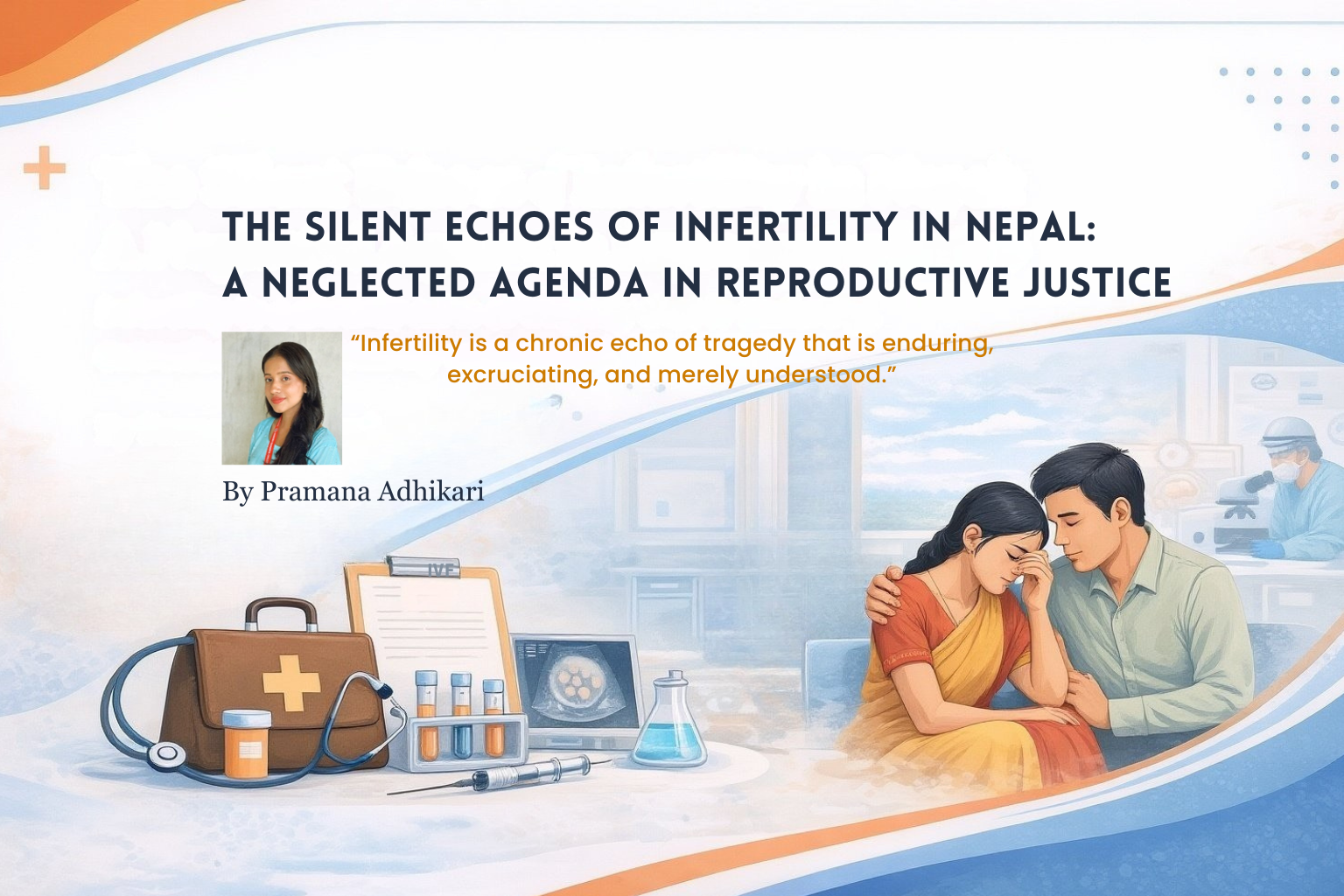
0 Likes
565 views
In Nepal, where ancestry and legacy are intricately woven into the cultural fabric, the inability to conceive is frequently viewed as a serious personal shortcoming rather than a medical illness. Infertility is a chronic echo of tragedy that is enduring, excruciating, and merely understood. While still being a medical condition it has the power to overrule the deepest aspect of social determinants of health whose presence is mostly felt somewhere deeply in the private corners of many households, where women bears the unseen scars of social pressure, self-blame and stigma (Bista 2015). Marital hardship, mental distress, and silent suffering become typical. Regardless of the medical cause, women are often singled out for blame and frequently face pressure from extended family members, subtle exclusion from family customs, or even threats to their marital stability and quality of life (Bista 2015; Pradhan Shrestha, Bhandari, and Pradhan 2020).
However, its origin is deeply ingrained in the weakness of our healthcare system, our legislative frameworks, and our collective silence: still infertility is one of the least recognized public health problems in Nepal, despite having shaped the lives of many families. As per the Safe Motherhood and Reproductive Health Rights Act of 2075, Reproductive health is defined as the “physical, mental, and social health condition related to the reproductive system, process, and function,” which is impressively comprehensive. Despite infertility clearly falling within this definition given by the act, the term is yet not mentioned in the statue (UNFPA 2075).
Although infertility may not pose a serious threat to one’s life, it can have profound social and emotional repercussions. According to international policy evaluations, many nations do not acknowledge infertility as a disease, which leads to a lack of public funding, stringent reimbursement standards, and insufficient psychosocial support (Adamson et al. 2025). Thus, raising a big question, “Did Nepal fail to acknowledge infertility as disease?” omission of infertility from the policy agenda is serious moral and structural mistake as Nepal works towards gender equity and universal health coverage (Infertility: Agony in developing countries 2024).
Couples frequently switch private clinics, driven more by hope and desperation than by evidence-based treatments.
Despite providing modern facilities and services, private fertility centers function in an unregulated environment. There is no central body that keeps an eye on patient safety, ethical guidelines, treatment costs, or success rates. Families are left to negotiate a costly and complicated system without responsibility, transparency, or protection.
The Act requires the federal, provincial, and local governments to provide yearly funds for programs related to reproductive health and safe motherhood. However, these funds are only allocated to safe- abortion, obstetric emergencies, pregnancy and childbirth without a specific budget line for treatment, counselling, or screening for infertility. The operational and budgetary framework completely ignores infertility, despite the law’s own definition (UNFPA 2075).
The biggest obstacle is still affordability. The majority of people in Nepal cannot afford infertility treatment because it is completely out of pocket. A single IVF cycle can cost many people more than many years’ worth of household income. In an attempt to have a biological child, families mortgage land, take out high interest private debts from family, friends or relatives, or deplete their life savings, often with little knowledge of the likelihood of success. Many couples attend clinics with the expectation that one or two treatment cycles will be inexpensive, only to discover their requirement to undergo for more costly repetitive treatments. Private clinics profit directly from this emotional vulnerability because there is no pricing regulation or open reporting of success rates. With all those struggles and hope in waiting rooms, couples fantasize about their future if they are successful in becoming pregnant. Invasive treatments, recurring disappointments, and the overwhelming burden of social blame are all experienced by women. Financial stress and the anxiety of not being able to “provide” a route to parenting are quiet burdens carried by men. Hope becomes both a trap and a lifeline in such precarious situations. Because the infertility market is unregulated, the financial spiral is not an accident.
Without worrying about regulations, clinics are free to charge what they want, make unfulfilled promises, and suggest needless operations.
Realistic success percentages and comprehensive explanations of their diagnosis are rarely given to couples. Rather, the rhetoric of hope turns into a commercial strategy. Many couples might hear, “you still have a chance,” when a doctor offers, “Let’s try one more cycle.” And families frequently comply even when they cannot afford it, because the desire for a child is so intensely emotional and culturally reinforced. Thus, Couples are forced into a traumatizing cycle by this financial burden, mental pain, and societal pressure, which is rarely acknowledged in policy discussions.
Inequity is also sustained by neglecting infertility. Even more obstacles stand in the way of rural couples’ already limited access to basic healthcare treatments. It is costly physically exhausting to go to urban areas for treatment. Many times, people completely give up on treatment, not because they don’t want children, but rather because there isn’t a viable alternative provided by the system (Thapa 2022). This unequal setting is a reflection of a deeper problem with Nepal’s healthcare system: reproductive health treatment is incomplete when those who are infertile are excluded.
There are no comprehensive national strategy or legally binding rules for treating infertility in Nepal, and only 45.1% of the country’s 51 ART centers have formal licenses from the Ministry of Health and Population. The current regulatory framework is still being discussed. Large rural areas lack access because majority of services are provided by the private sector (94% of the centers) and are centered in the Kathmandu valley (66.7% of facilities). Only one center provides data to the International Committee for Monitoring Assisted Reproductive Technology (ICMART), and we do not have a national ART registry (Creator’s IVF Nepal Pvt. Ltd., Satdobato, Lalitpur, Kathmandu, Nepal and Shrestha (Pradhan) 2025). Infertility, assisted reproduction, and surrogacy were highlighted at a recent consultative meeting hosted by the center for Reproductive Rights, which included parliamentary participation and a rights-based briefing (wideeye 2023). However, the main policy texts in Nepal concentrate on other areas. Infertility is not mentioned in the UNFPA country program (2023-2027), which emphasizes universal access to SRH but focuses on “reducing preventable maternal deaths, unmet need for family planning, gender-based violence, child marriage and other harmful practices.”(UNFPA Country Programme Document for Nepal (2023-2027) n.d.).
In Nepal, addressing infertility is a matter of rights, dignity, and fairness in the healthcare system in addition to being a medical requirement. More than just expanding services, acknowledging infertility as a public health priority restores hope and dignity to people who have been waiting in silence. Government cannot ignore the pain of an entire community while working towards an inclusive health system. Political will, policy commitment, and a humane recognition that having a family is a human objective deserving of support and protection and are vital for the future.
Because when the system is unregulated, desperation becomes an opportunity for exploitation.
Leaving us with often uncomfortable and a self-reflecting question and creates room for doubt in our health policy,Are our problems being addressed or are they being exploited for personal gains? Therefore, the path forward demands that infertility must be acknowledged as a public health priority in Nepal immediately, and the public system must incorporate easily accessible and reasonably priced services. To regulate fertility clinics, cost transparency must be ensured while protecting patients from unlawful conduct. Standards clinical procedures must be put guided by national regulatory framework in place.
References
About the Author
Pramana Adhikari is a Registered Public Health Professional with the Nepal Health Professional Council and holds a Bachelor in Public Health from Pokhara University. Her work integrates public health and sociological perspectives, with a primary focus on reproductive health, public health issues, and child nutrition.
Share on social media
SHARE
Recent Articles
View all
Kathmandu Metropolitan Scholarship 2026 | Study +2 in Top Colleges for Free
Charlie Prince Shah
30 April, 2026 | 5 min read
Why do most people over 40 require glasses for near vision?

Roshna Bhuju
17 February, 2026 | 4 min read
Beyond ‘Ke Sochla Samaj?’: Nepal’s Slow but Strong Mental Health Revolution

Sankalpa Gautam
17 February, 2026 | 3 min readPayment Partners


Download our app


© Copyright2024.e-Shiksha Network. All rights reserved.